
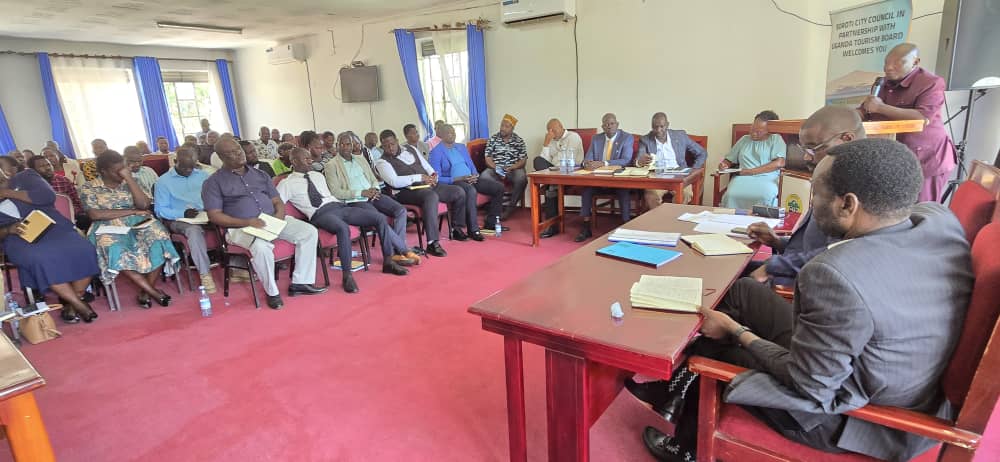
Political leaders from across the political divide in Soroti City have committed to working together with technical staff to accelerate development and improve service delivery in what participants described as the city's first strategic engagement bringing together leaders across party lines since Soroti attained city status.
The meeting, held at Soroti City Hall on Thursday, brought together Members of Parliament from the National Resistance Movement (NRM) and the opposition, city and division mayors, councillors, technical officers and security officials. It was chaired by NRM Vice Chairperson for Eastern Uganda, Calvin Echodu.
The leaders agreed to prioritize local revenue enhancement, road infrastructure, sanitation, security, healthcare, industrialization and youth employment as key pillars of the city's development agenda.
Addressing the meeting, Echodu said the engagement was intended to strengthen collaboration between political and technical leaders while taking stock of the city's development needs.
"We want to understand what we have, what we do not have, and what we need to achieve. Once we understand the city we are working with, it becomes easier for us to coordinate and deliver on the promises made to the people," he said.
He urged city leaders to align Soroti's development priorities with the National Development Plan IV (NDP IV) and the NRM manifesto, while calling for improved local revenue collection to reduce the city's dependence on central government funding.
Echodu noted that Soroti remains among the least-funded cities because of its limited local revenue base and challenged leaders to expand the city's revenue sources.
He also called for urgent improvements in sanitation, saying a clean environment is critical for attracting investment.
"If Soroti wants to attract investors, we must become one of the cleanest cities. No investor will bring millions of dollars to a city that is dirty and unsafe," he said.
Soroti East Division Member of Parliament Moses Attan Okia said the leaders had agreed to institutionalize quarterly review meetings to assess progress on agreed development priorities and strengthen accountability.
"We have identified local revenue leakage, poor garbage management, inadequate infrastructure, and underutilization of the industrial park as key challenges that require immediate intervention," Attan said.
He added that the leaders would engage the Ministry of Trade and Industry to ensure land allocated in the industrial park is either developed or reallocated to investors prepared to establish industries.
Attan also warned against political favoritism in the implementation of government programmes.
"Government programmes should not benefit relatives and friends of local leaders. Every qualifying citizen deserves equal access to government opportunities," he said.
Soroti Resident City Commissioner John Michael Okurut called for collective action to tackle rising insecurity, youth involvement in criminal gangs and the illegal occupation of public spaces.
He attributed much of the growing juvenile crime to unemployment and family breakdowns, urging leaders to prioritize interventions targeting vulnerable young people.
"Security is a collective responsibility. Many of the young people engaging in crime are idle and frustrated. We must work together to address the root causes," Okurut said.
Soroti City Town Clerk Paul Batanda highlighted critical staffing shortages in the health sector, revealing that the city requires more than Shs2.1 billion to recruit 97 essential health workers and nearly Shs4 billion to fill all approved positions.
"Our health staffing level is below 45 percent. We need urgent support to recruit nurses, midwives and other essential health personnel," Batanda said.
Soroti East Division Mayor Latif Abdul called for improvements in traffic management, enforcement of trade order and expansion of health infrastructure.
He said buses and taxis continue to operate along roads despite the existence of designated parks, worsening congestion within the city centre.
Abdul also appealed for government support to equip the city mortuary, upgrade Soroti Regional Referral Hospital and establish a teaching hospital linked to Soroti University.
Councillors and technical officers also raised concerns about persistent revenue leakages, weak tax enforcement, inadequate road maintenance equipment and alleged interference by influential individuals in city operations.
The meeting concluded with a commitment by political and technical leaders to set aside partisan differences and jointly pursue a common development agenda aimed at transforming Soroti into a cleaner, safer and more prosperous city over the next five years.
